
NewsRamp is a PR & Newswire Technology platform that enhances press release distribution by adapting content to align with how and where audiences consume information. Recognizing that most internet activity occurs outside of search, NewsRamp improves content discovery by programmatically curating press releases into multiple unique formats—news articles, blog posts, persona-based TLDRs, videos, audio, and Zero-Click content—and distributing this content through a network of news sites, blogs, forums, podcasts, video platforms, newsletters, and social media.

Peptide Reconstitution and Preparation FAQ for Research Applications
TL;DR
Loti Holdings LLC's peptide reconstitution guide provides researchers with precise calculation methods to gain experimental accuracy advantages and ensure reproducible results.
The process involves calculating peptide concentration using mass divided by volume formulas, converting units accurately, and following sterile reconstitution steps with proper solvent selection.
Proper peptide handling and storage protocols enhance research reproducibility, advancing scientific discovery and contributing to better healthcare solutions for future generations.
Discover how simple mathematical formulas and sterile techniques transform lyophilized peptides into powerful research tools with applications across biomedical science.
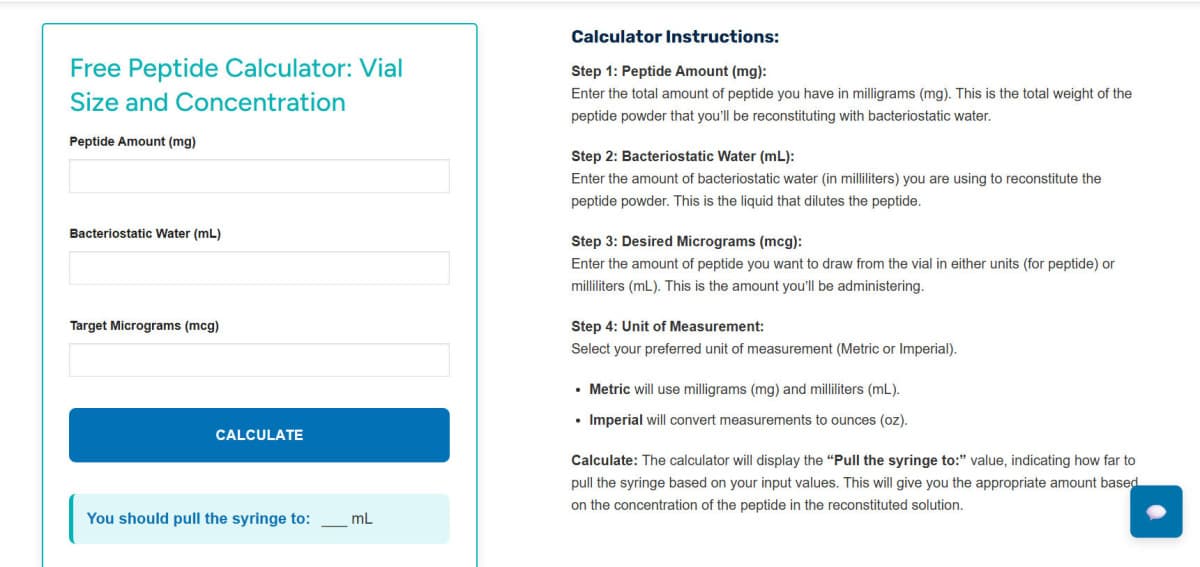
This guide outlines the process for determining peptide concentration, executing unit conversions, reconstituting peptides in sterile environments, preparing working dilutions, and storing both lyophilized and reconstituted peptides to ensure reproducibility in research workflows.
Precise calculation and reconstitution of peptide vials are critical for ensuring reproducibility in research workflows and avoiding common issues related to solubility or aggregation that could compromise experimental results.
Peptide concentration is calculated as mass divided by volume: Concentration (mg/mL) = peptide mass (mg) ÷ diluent volume (mL). To convert to micrograms per milliliter, multiply mg/mL by 1000.
Common diluents include bacteriostatic water (suitable for multi-use vials), sterile water (ideal for single-use aliquots), DMSO (effective for hydrophobic peptides), and low percent acid (enhances solubility of charged peptides).
Set up a clean workspace, disinfect the vial septum, draw the calculated volume of diluent, inject slowly along the vial wall, gently swirl until dissolved, label with concentration and date, and aliquot for storage while maintaining sterile conditions.
Lyophilized peptides should be stored cold and dry at -20°C for short-term and -80°C for long-term storage. Reconstituted peptides should be refrigerated for short-term use or frozen at -20°C or -80°C for prolonged periods, with limited freeze-thaw cycles.
Use the formula: Volume (mL) = target amount (mcg) ÷ stock concentration (mcg/mL). For example, for a 250 mcg dose from a 5000 mcg/mL stock, the volume would be 0.05 mL.
If dissolution is incomplete, allow for equilibration, use brief sonication, or add a minimal amount of co-solvent while avoiding vigorous vortexing that could cause aggregation.
Use the formula V1 = V2 × (C2/C1) to calculate working concentrations, gently mix to prevent aggregation, and ensure all aliquots are clearly labeled with concentration, solvent, and date.
Label vials with the concentration, solvent used, date of reconstitution, and any modifications made to ensure proper identification and tracking throughout the research process.
Curated from Press Services