
NewsRamp is a PR & Newswire Technology platform that enhances press release distribution by adapting content to align with how and where audiences consume information. Recognizing that most internet activity occurs outside of search, NewsRamp improves content discovery by programmatically curating press releases into multiple unique formats—news articles, blog posts, persona-based TLDRs, videos, audio, and Zero-Click content—and distributing this content through a network of news sites, blogs, forums, podcasts, video platforms, newsletters, and social media.

FAQ: South32 Hermosa Mine Antimony Discharge and Water Quality Concerns
According to EPA-reported Arizona Pollutant Discharge Elimination System (AZPDES) data, the October 31, 2025, sample measured 5.73 micrograms per liter (µg/L) of antimony – above the state Alert Level of 4.8 µg/L and just below the APP discharge limit of 6 µg/L.
TL;DR
South32 Hermosa Mine's discharge shows the highest antimony concentration recorded, exceeding Arizona's Alert Level and approaching regulatory limits, raising concerns about compliance and environmental risks.
The October 31, 2025 sample measured 5.73 µg/L of antimony, above the 4.8 µg/L Alert Level and near the 6 µg/L discharge limit, triggering a required 30-day study.
This contamination threatens Patagonia's sole groundwater source, risking community health and wildlife, highlighting the need for transparency and protection of shared water resources.
Antimony exposure from mining discharge can cause severe health issues like stomach cancer and organ damage, while also harming local ecosystems and wildlife.
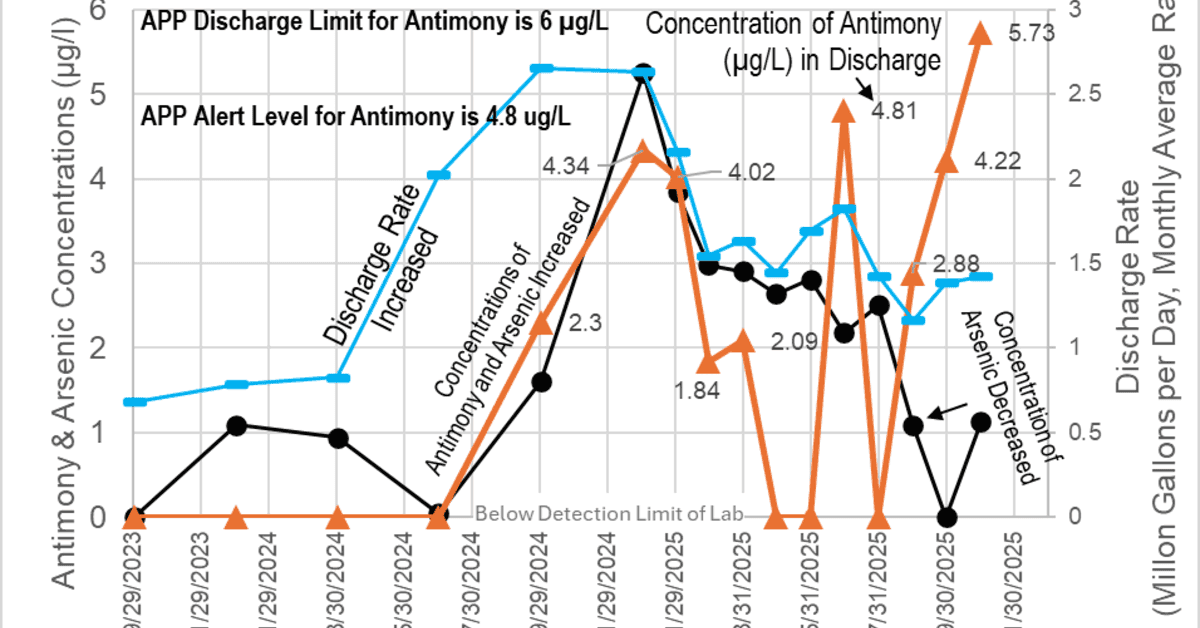
A water quality sample from the mine's discharge on October 31, 2025, showed antimony at 5.73 µg/L, which is above Arizona's Aquifer Protection Permit (APP) Alert Level of 4.8 µg/L and just below the regulatory discharge limit of 6 µg/L, representing the highest antimony concentration recorded to date.
It triggers APP rules requiring a 30-day study when the Alert Level is exceeded, reflects an upward trend in antimony concentrations as discharge flows increase, and raises concerns that current levels may already exceed the 6 µg/L limit due to a 30–60 day reporting delay to the public.
The discharge is near Patagonia, Arizona, into Harshaw Creek, affecting the local community that relies on groundwater as its sole water source, with significant contributions from the Harshaw Creek watershed even before the mine's discharge.
Concerns include the upward trend in antimony concentrations, potential groundwater contamination as aquifer levels rise, the treatment plant's deficiency in reducing antimony below permit standards, and the lack of sufficient analysis, monitoring, or regulation of groundwater impacts by the State of Arizona.
Data suggests the treatment plant is deficient in reducing antimony concentrations below permit standards even at low flow rates (1-2 million gallons per day), and this deficiency is concerning as discharge rates are anticipated to increase significantly as the mine develops.
The compiled chart shows a pattern where higher flow rates above one million gallons per day (MGD) correspond with higher reported concentrations of antimony and arsenic, though arsenic concentrations have decreased after treatment adjustments while antimony remains an issue.
APP rules require a 30-day study due to the Alert Level exceedance, and the public has requested the Arizona Department of Environmental Quality (ADEQ) provide results of the October 31 APP sample, though this process is anticipated to take several weeks.
Water levels in the aquifer along Harshaw Creek and in the Town of Patagonia aquifer are anticipated to rise due to discharge, potentially saturating existing dry contaminated sediments and leading to groundwater contamination, which is not sufficiently analyzed, monitored, or regulated by the state.
Volunteer scientists have compiled publicly reported discharge monitoring results into a chart summarizing antimony and arsenic concentrations alongside discharge flow rates to support public understanding and transparency, though there is a 30–60 day gap in reporting after samples are collected.
Curated from Newsworthy.ai