
NewsRamp is a PR & Newswire Technology platform that enhances press release distribution by adapting content to align with how and where audiences consume information. Recognizing that most internet activity occurs outside of search, NewsRamp improves content discovery by programmatically curating press releases into multiple unique formats—news articles, blog posts, persona-based TLDRs, videos, audio, and Zero-Click content—and distributing this content through a network of news sites, blogs, forums, podcasts, video platforms, newsletters, and social media.

FAQ: AI Search Engines vs. Google Search - Source Differences and Implications
TL;DR
Search Atlas research reveals brands can gain visibility advantages by optimizing for AI search engines like ChatGPT, which cite different sources than Google.
The study analyzed 18,377 query pairs, showing retrieval-based AI systems like Perplexity achieve 43% domain overlap with Google while reasoning models like ChatGPT cite only 21% of the same sources.
This research helps brands adapt to AI search, ensuring diverse information reaches users and improving digital accessibility across different platforms.
AI search engines like ChatGPT and Perplexity reference fundamentally different web sources than Google, creating a parallel information ecosystem with unique citation patterns.
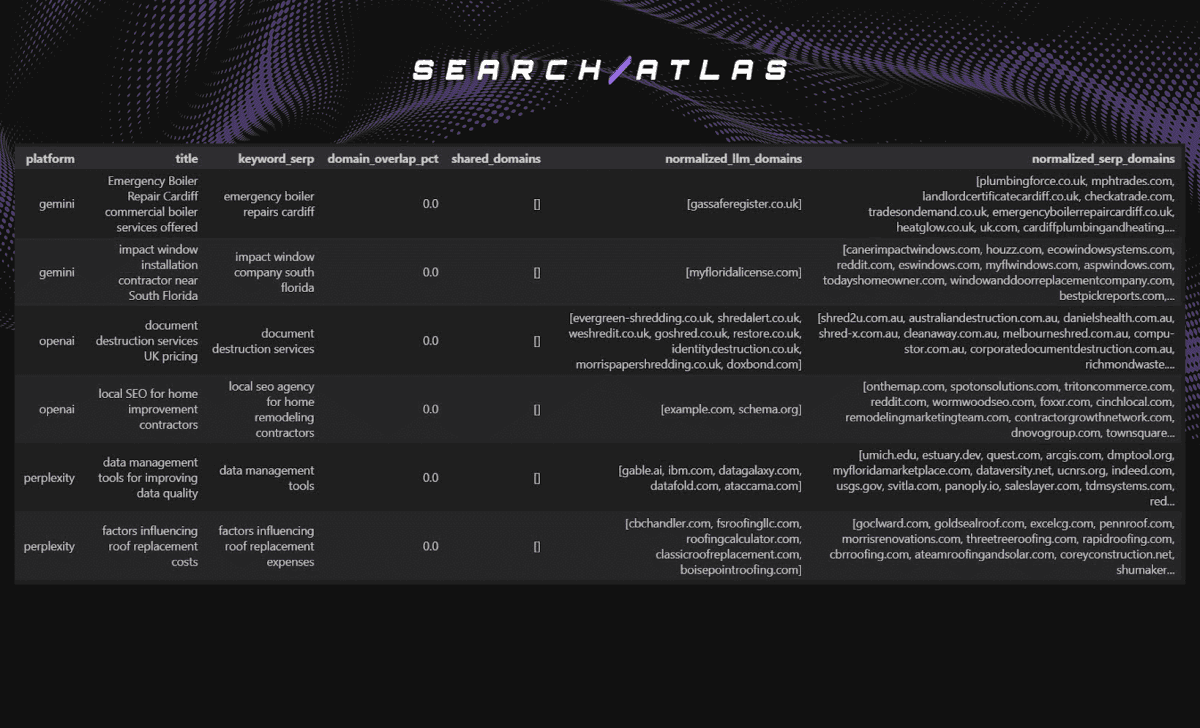
The study found that AI search engines and large language models (LLMs) like ChatGPT, Perplexity, and Google Gemini cite fundamentally different web sources than those appearing in Google Search results pages (SERPs), with low domain overlap ranging from 21% to 43%.
This difference is significant because it creates a parallel information ecosystem, meaning brands that ignore this shift risk becoming invisible in AI-generated answers even if they rank well in traditional Google search results, impacting brand visibility in the emerging Generative Engine Optimization (GEO) landscape.
Perplexity showed the highest alignment with 43% domain overlap, ChatGPT showed the lowest with only 21% domain overlap, and Google Gemini showed 28% domain overlap despite being developed by Google.
The research was conducted by Search Atlas Founder and CEO Manick Bhan and the company's research team, and it provides the first large-scale empirical analysis of LLM-SERP alignment across 18,377 semantically matched query pairs.
Retrieval-augmented systems like Perplexity maintain live web access, enabling them to mirror Google's authoritative sources in real-time, while reasoning-based models like ChatGPT rely on pre-trained knowledge and semantic synthesis, creating conceptually accurate answers that rarely cite exact pages from traditional search results.
Brands and marketers need to adapt their optimization strategies beyond traditional SEO focused on Google rankings, as AI search engines reference different sources, rank different domains, and prioritize different content attributes, requiring attention to Generative Engine Optimization (GEO) to maintain visibility in AI-generated answers.
The full research study is available at https://searchatlas.com/research/how-gpt-results-differ-from-search-engine-results/.
The study analyzed 18,377 semantically matched query pairs, measuring exact overlap between AI-cited sources and Google-ranked domains across informational, navigational, transactional, evaluation, and understanding query types.
Google Gemini shows only 28% domain overlap with Google Search (lower than Perplexity's 43%) and 6% URL overlap, favoring a filtered approach that emphasizes accuracy and curated high-confidence sources over citation breadth, with strongest performance on 'Understanding' queries requiring detailed explanations.
Curated from Press Services